You would have to have been buried under a mountain with no telecommunications to be unaware of the storm of comment and controversy unleashed by the release of the ClimateGate emails. I've been peripherally following some of the debate on Roger Pielke Jr.'s Blog, and frankly, I'm glad I'm an ecologist working on something as unimportant as the management of big rivers! I just read an amazing discussion in the blog comments on an interview of Judith Curry by Keith Kloor. Dr. Curry is a climate scientist, up until last November a public advocate of the IPCC conclusions, and more recently a reluctant public commentator on what climate science needs to do now. Dr. Curry's replies in the comments section set a high standard for reasoned and polite responses to comments that are frankly, rude and insolent.
Dr. Curry's essay on trust is short, and worth a read - my favourite quote: "Debating science with skeptics should be the spice of academic life ...". I couldn't agree more. I've thought the blogosphere might be a great tool to enable such debates - but the climate science blogs sometimes leave me hoping mine doesn't go that way!
Sunday, April 25, 2010


Tuesday, April 20, 2010
Optimizing for multiple objectives
A few weeks ago Wayne Thogmartin and I were having a discussion about tradeoffs, and I commented that I thought everyone knew it was impossible to simultaneously maximize more than one objective.
Apparently not. However, here is a cool little online game that Wayne put me onto - you get to decide how to allocate California's water supply between Agriculture, Environment, and Urban uses, and then it tells you whether you matched the current allocation or not. Maybe if people play enough games like this they'll start to figure out the tradeoff thing. Although it's interesting that they use the existing allocation as the only one that works ... actually let me rephrase that - I just tried again and NONE of the allocations works - they all tell you you've failed! Hey, it is actually representing reality ...
Sunday, April 18, 2010
No simple formulas
Here's an excerpt from an interview with Elinor Ostrom by Fran Korten in Yes magazine. Ostrom won the 2009 Nobel Prize in Economics for her work on how people cooperate:
Yah - I agree! At the supermarket now there are labels that provide a single number, the products "NuVal", which is supposed to help people make better decisions on what to eat. Right.
And along the lines of simple formulas, Yes magazine also has a list of 8 rules for governing a commons so you don't have to read Ostrom's famous book. Interesting to see how many of them are broken by the governance of the Missouri River.
Fran: If you were to have a sit-down session with someone with a big influence on natural resources policy say Robert Zoellick, head of the World Bank, or Ken Salazar, Secretary of the U.S. Department of the Interior, what would be your advice?
Elinor: No panaceas! We tend to want simple formulas. We have two main prescriptions: privatize the resource or make it state property with uniform rules. But sometimes the people who are living on the resource are in the best position to figure out how to manage it as a commons.
Yah - I agree! At the supermarket now there are labels that provide a single number, the products "NuVal", which is supposed to help people make better decisions on what to eat. Right.
And along the lines of simple formulas, Yes magazine also has a list of 8 rules for governing a commons so you don't have to read Ostrom's famous book. Interesting to see how many of them are broken by the governance of the Missouri River.
Friday, April 16, 2010
Rapid prototype of an expert system
Expert systems can be useful for certain types of situations. However, this one confused fundamental objectives with actions in an unhealthy way - This is an egregious example of making inappropriate normative assumptions about the behavior of individuals.
Monday, April 12, 2010
Bigger models not needed
Skip Stiles worked many years as a congressional staffer, and by his own admission, wished for better climate change predictions. He seems to have seen the light, as highlighted in this guest post at Roger Pielke Jr.'s Blog. He is responding to the recent announcement of a $50 million multi-agency program to fund the development of better climate models. While I agree with Stiles that the $50 million could be better spent, I wish he'd reserve at least a bit of it for interdisciplinary research on how to structure science to be more useful to policy.
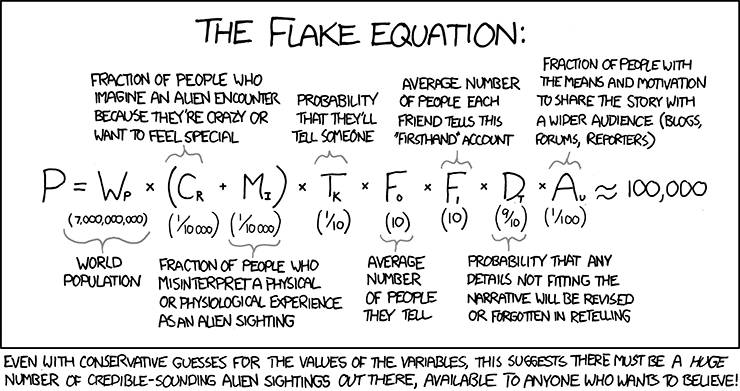
How's this for a rapid prototype model (Courtesy of xkcd.com):
Welcome to the cyborg planet!
Human Landscapes is an intriguing blog that I follow from time to time. This post on bringing nature in to create a cyborg planet is intriguing. Myself, I'm not sure more information about the planet is going to help, as long as we humans can't agree on what we want the planet to provide.
Wednesday, April 7, 2010
The AM process
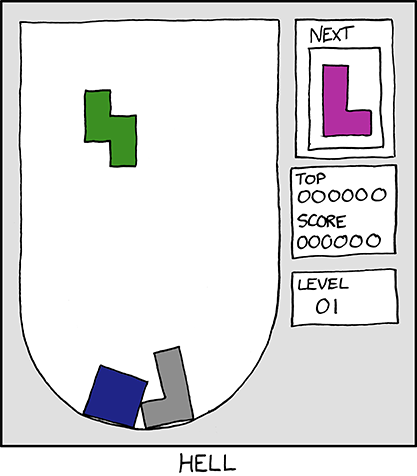
A colleague, who may prefer to remain nameless, suggested that this comic be used as the primary diagram for the AM process:
Subscribe to:
Posts (Atom)

 Posts


